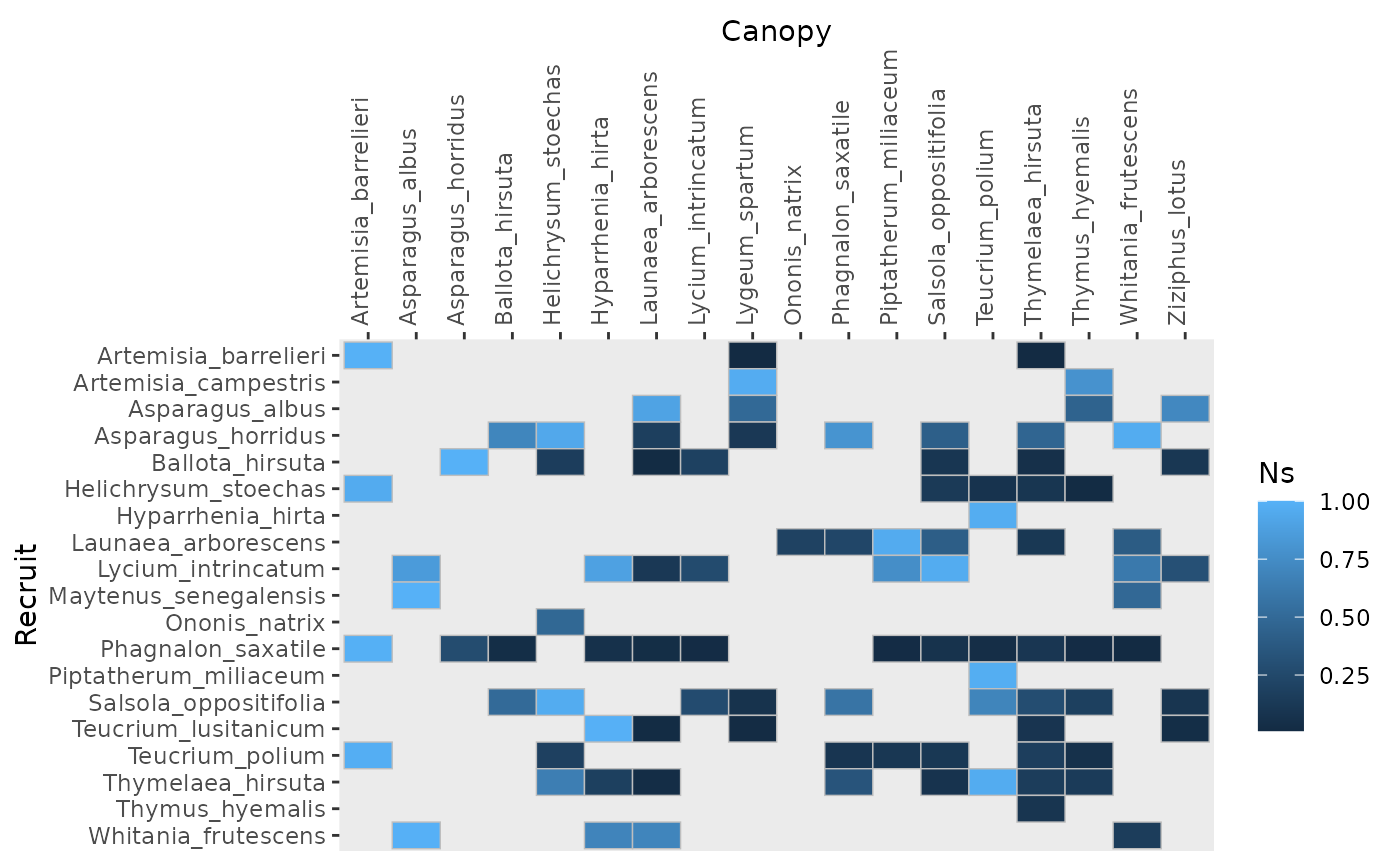
Visualize a heatmap of the interactions matrix.
Arguments
- int_data
data frame containing interaction data.
- cover_data
data frame with the abundance of each canopy species in each plot.
- int_type
#' Indicates the type of plant-plant interaction that will be presented in the output matrix: general recruitment, recruitment enhancement (i.e. facilitation) or recruitment depression (i.e. competition). It may take three possible values:
rec: Estimates the node degree based on all plant-plant interaction that contribute to recruitment.
fac: Estimates the node degree based on only those pairwise interactions that enhance recruitment. Not every observed interaction in the field has to be present in the matrix. In this case non-detected interactions are not considered and "Open" is not included as a canopy species category.
comp: Estimates the node degree based on only those pairwise interactions that depress recruitment. Not every observed interaction in the field has to be present in the matrix. However, in this case non-detected interactions are considered (i.e. expanding with 0 all possible interactions in the study system). "Open" is not included as a canopy species category.
- weight
Specifies the metric used to represent interaction strength (i.e., the weight) assigned to each pair of species in the matrix. See function associndex for further details. The possible options are:
Fcr: frequency of recruitment in number of recruits by canopy-recruit pair.
Pcr: presence/absence (1/0) of the interaction (unweighted network).
Dcr: density of recruitment as number of recruits per unit area of canopy species.
Dro: density of recruitment in open interspaces as number of recruits per unit area of open interspaces.
Ns: The index Normalized Neighbour Suitability index (proposed by Mingo, 2014), suitable for comparisons of interaction strength between pairs of species within a local community, which should be preferred in general recruitment networks (Alcantara et al. 2025).
NIntA: The index additive symmetry intensity index proposed by Diaz-Sierra et al. (2017).
NIntC: The index commutative symmetry intensity index proposed by Diaz-Sierra et al. (2017).
RII: The index Relative Interaction Index (Armas et al., 2004).